Skills
1. What are MemOS Skills?
Skills are modular capability packages that an Agent can dynamically invoke while executing tasks. They are automatically dispatched and injected by the Agent based on the conversation context, requiring no manual intervention from the user. These skills are typically built by developers collaborating with LLMs, based on open-source projects or original concepts, and are continuously optimized through actual use.
MemOS advocates that "Memory is Asset." We believe that the resolution paths and user preferences precipitated in real conversations are essentially the most valuable materials for skills. Based on this philosophy, MemOS now supports automatically extracting skills from user memories—solidifying fragmented interaction histories into reusable, personalized professional capabilities.
- Static Facts → Dynamic Execution
- Fragmented → Structured
2. How It Works
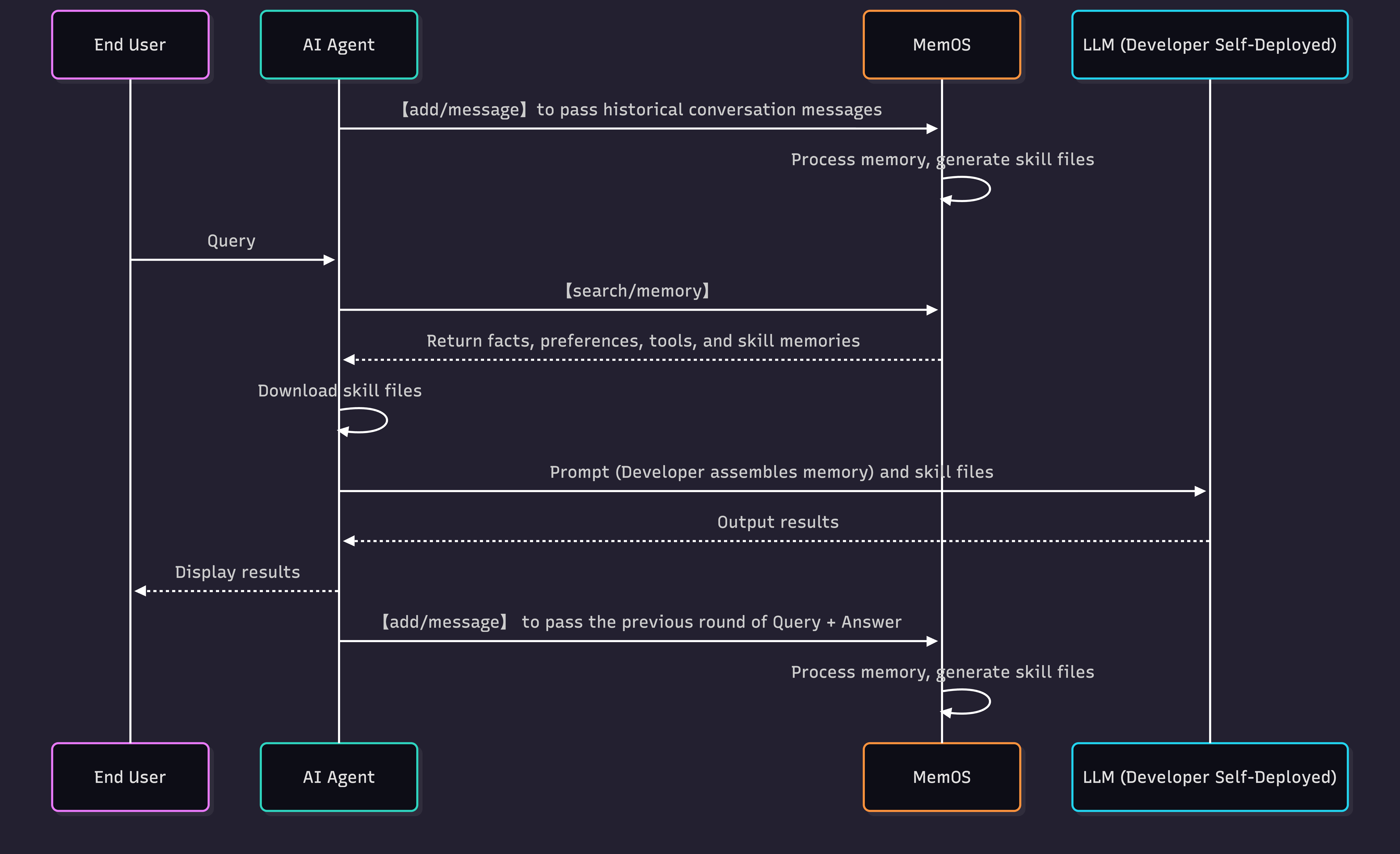
The diagram above illustrates the complete interaction flow between the end-user, your AI Agent, and MemOS:
- Call the
add/messageinterface to pass the user's conversation messages into MemOS. - Upon receiving the request, MemOS processes it in sequence to generate a Skill file:
a. Intelligent Slicing: Identifies task boundaries in historical conversations and slices them into task text blocks.
b. Clustering & Extraction: Clusters similar task blocks and combines them with the user's historical memory to extract structured skill text.
c. Skill Transformation: Converts the skill into an executable and recognizable Skill file. - Call the
search/memoryinterface to retrieve memories. MemOS will return a unified result including context-related user facts, preferences, tool memories, and matching Skill files. - Download the Skill file and pass both the memories and the Skill file to your self-deployed LLM, enabling the effective utilization of long-term experience and automatically generated skills.
3. Usage Example
The following demonstrates an example of MemOS generating a "Travel Planning" skill based on historical conversations.
1. Add Messages
Add a conversation between a "High-Energy J-type person" and a "Travel Planning Assistant." The user expresses several requirements for the trip:
- Dislikes backtracking; "Special Forces" style (intensive) travel.
- Prefers cultural attractions.
- Needs to confirm weather and temperature in advance.
import os
import requests
import json

# Replace with your API Key
os.environ["MEMOS_API_KEY"] = "YOUR_API_KEY"
os.environ["MEMOS_BASE_URL"] = "https://memos.memtensor.cn/api/openmem/v1"

data = {
    "user_id": "memos_user_123",
    "conversation_id": "0127",
    "messages": [
      {"role": "user", "content": "I'm going to Chengdu next week. Help me plan a 5-day trip. I like 'Special Forces' style travel without backtracking. Please mark delicious local food along the way."},
      {"role": "assistant", "content": "...omitted..."},
      {"role": "user", "content": "I prefer visiting cultural sites; I'm not very interested in shopping malls."},
      {"role": "assistant", "content": "...omitted..."},
      {"role": "user", "content": "When planning, please check the weather and temperature in advance so I can pack my luggage."},
      {"role": "assistant", "content": "...omitted..."}
    ]
  }
headers = {
  "Content-Type": "application/json",
  "Authorization": f"Token {os.environ['MEMOS_API_KEY']}"
}
url = f"{os.environ['MEMOS_BASE_URL']}/add/message"

res = requests.post(url=url, headers=headers, data=json.dumps(data))

print(f"result: {res.json()}")
2. Retrieve Memory
Suppose the user makes another travel planning request. Pass the user's query and enable skill recall:
import os
import requests
import json

# Replace with your API Key
os.environ["MEMOS_API_KEY"] = "YOUR_API_KEY"
os.environ["MEMOS_BASE_URL"] = "https://memos.memtensor.cn/api/openmem/v1"
data = {
  "query": "I plan to go to Yunnan during the Qingming Festival. Help me plan a 7-day itinerary.",
  "user_id": "memos_user_123",
  "conversation_id": "0301",
  "include_skill": True # Enable skill
}
headers = {
  "Content-Type": "application/json",
  "Authorization": f"Token {os.environ['MEMOS_API_KEY']}"
}
url = f"{os.environ['MEMOS_BASE_URL']}/search/memory"

res = requests.post(url=url, headers=headers, data=json.dumps(data))

print(f"result: {res.json()}")
3. Result Display
In the retrieval results below, the skill includes:
- Planning "Special Forces" itineraries.
- Recommending cultural attractions.
- Focusing on weather/temperature and recommending suitable clothing.
# Below is the Skill.md generated by MemOS

---
name: Travel Itinerary Planning
description: Design multi-day itineraries for travelers, including attraction arrangements, transportation, and weather adaptation suggestions.
---

## Procedure
1. Determine the traveler's interests and preferences 2. Gather information on attractions and activities at the destination 3. Plan the daily itinerary, ensuring high efficiency and no backtracking 4. Add local food recommendations to enrich the experience 5. Provide transportation and accommodation suggestions, balancing convenience and comfort 6. Check weather forecasts, adjust the itinerary, and prepare luggage

## Experience
1. Efficient route design reduces commute time
2. Prioritize attractions; avoid overly commercialized places
3. Food recommendations increase the richness of the experience
4. Weather adaptation ensures comfortable travel

## User Preferences
- Itinerary arrangements without backtracking
- Priority for cultural attractions, focusing on history and cultural experiences
- Adjust itinerary and prepare luggage based on weather

## Examples

### Example 1

# Travel Itinerary Planning Example
## Day 1
- **Itinerary**: Panda Base → Eastern Suburb Memory → Jianshe Road Food Street
- **Weather Adaptation**: Cloudy and windy, suitable for visiting cultural districts
- **Food Recommendation**: Juntun Guokui (Pot-baked pancake), Soy milk
- **Transportation**: Subway + Walking

## Day 2
- **Itinerary**: People's Park → Chengdu Museum → Wenshu Monastery
- **Weather Adaptation**: Light rain, focus on indoor museums
- **Food Recommendation**: Zhong Dumplings, Chen Mapo Tofu
- **Transportation**: Subway + Ride-hailing

...

## Additional Information

### Luggage Preparation Guide
Based on destination weather characteristics, use the "onion layering" method for easy adjustment.

### Cultural Attraction Reservation Guide
Provide reservation channels, ticket prices, and opening hours.
- If the Model/Agent you call has the capability to use Skill files, you can directly download the file from the
skill_urllink. - If the Model/Agent you call does not have the capability to use Skill files, you can directly convert
skill_valueinto a string and add it to the prompt.
4. Build Your Personalized Skills
Based on different users' conversation messages, MemOS can create skills exclusive to individuals. For instance, we constructed another conversation between a "Low-Energy P-type person" and a "Travel Planning Assistant." When they requested:
- Night owl, can't get up early.
- Doesn't want to go to far-off places that require rushing.
- Interspersed with niche attractions, off the beaten path.
The Skill file built by MemOS included:
- Planning afternoon-to-evening, relaxed itineraries.
- Recommending routes that aren't too far or rushed.
- Interspersing niche attractions.
# Below is the Skill.md generated by MemOS
---
name: Travel Itinerary Planning
description: Help users plan travel itineraries, ensuring comfortable and efficient exploration of the destination.

---

## Procedure

1. Determine travel purpose and preferences 2. Gather information on destination attractions and activities 3. Filter attractions based on user preferences 4. Arrange daily schedules, including transportation and dining 5. Provide tips and precautions

## Experience

1. Avoid long-distance travel; choose attractions with convenient transportation
2. Reasonably arrange daily schedules, balancing leisure and exploration
3. Fully utilize nighttime activities and attractions to enhance the travel experience
4. Discover niche attractions to avoid crowds and enjoy unique experiences

## User Preferences

- User prefers waking up late and avoiding long-distance travel
- Priority for attractions directly accessible by subway
- Values nighttime activities and experiences
- Explores niche and non-traditional travel routes

## Examples

### Example 1

### Day 1: Giant Panda Afternoon + Niche Old Street Night Tour
- **Noon**: Wake up naturally + Huixinglou Street Food
- **Afternoon**: Chengdu Research Base of Giant Panda Breeding
- **Evening**: Night tour of Shizi Alley + Guihua Alley + Paotongshu Street
...

### Example 2

### Day 2: Three Kingdoms Culture + Dongmen Market Night Market
- **Noon**: Wake up naturally + Wuhouci Street Food
- **Afternoon**: Wuhou Shrine + Red Walls and Bamboo Shadows
- **Evening**: Dongmen Market + Jiuyanqiao Bar Street
...
- Go to the Console - Skill Page to view Skill files automatically generated based on user conversation history.
- Don't have any skills yet? Just Add Messages to trigger generation.